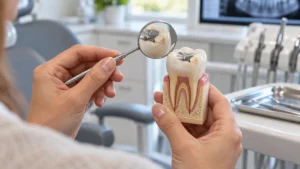
“Can this tooth be saved?” is usually the first question when a dentist finds infection inside or around a tooth. A root canal aims to remove diseased tissue while keeping the tooth. Extraction removes the tooth when it cannot be predictably saved or when another clinical reason makes removal the better choice. The decision depends on the tooth in front of the dentist, not on which option sounds faster online.
What a root canal does
During root canal treatment, a dentist or endodontist removes damaged or infected pulp, cleans and seals the canal space, then plans how to restore the tooth. The American Association of Endodontists explains that preserving the natural tooth can avoid the need to replace it with a bridge or implant. A final restoration may be necessary for strength, especially for a heavily damaged back tooth.
Our emergency root canal page describes the service. Whether the procedure can start at an urgent visit depends on the examination, scheduling, and the complexity of the tooth.
When extraction enters the discussion
A tooth may be too damaged to restore if there is extensive decay, a deep fracture, or too little healthy structure remaining. The condition of the supporting gum and bone also matters. Extraction removes the tooth, but the dentist should discuss what happens to the space afterward and whether a replacement is advisable. Our emergency extraction page explains that option.
Ask the dentist to show you the specific reason a tooth can or cannot be saved. If the answer is uncertain, ask whether consultation with an endodontist is appropriate. The AAE recommends considering tooth-saving options before extraction when they are clinically viable.
What the dentist needs to evaluate
- The source and extent of infection. Symptoms and examination may be supported by X-rays or other imaging.
- Restorability. Even a successful root canal needs enough sound tooth for a durable final restoration.
- Fractures and bone support. Some cracks or periodontal problems change the outlook.
- Your health and priorities. Medical history, pain, timeline, and the cost of treatment and any replacement all belong in the conversation.
Antibiotics do not replace a needed dental procedure. ADA guidance recommends definitive dental treatment for most tooth-related pain and localized swelling and reserves antibiotics for specific situations, such as systemic involvement. Do not start leftover antibiotics or assume medication alone will resolve the source.
Compare the full path, not just the first procedure
For a tooth that can be saved, the treatment path may include a root canal followed by a final restoration. Ask how much natural tooth remains and whether a crown or another restoration will be needed to protect it. If extraction is the recommended path, ask how the space affects chewing and whether a bridge, implant, or another replacement should be considered later. Those future steps affect cost, timing, and maintenance.
Consider two teeth with similar pain. One has a treatable infection and enough sound structure for a restoration; the other has a deep fracture that leaves too little structure to support a predictable repair. Their symptoms may feel alike, yet the dentist’s recommendation may differ. This is why the decision cannot be made by pain level or by the presence of an abscess alone.
If you are uncertain, ask the dentist to explain the image and the restoration plan in plain language. “What would have to be true for this tooth to be saved?” is often a more useful question than “Which procedure is better in general?”
Questions to ask before choosing
“What findings support this recommendation?” “If I keep the tooth, what restoration will it need afterward?” “If it is removed, what replacement options would you consider?” “What happens if treatment is delayed?” These questions turn a frightening choice into a clear plan.
When to get urgent help
Contact a dentist promptly for severe or persistent tooth pain, swelling, or a gum bump. If swelling affects breathing or swallowing, or you feel seriously unwell, seek emergency medical care. An infected tooth deserves assessment even if pain suddenly eases; that does not prove the infection is gone.
FAQ
Is extraction always cheaper?
The immediate extraction fee and the full cost of replacing the tooth are different questions. Ask for estimates for each clinically appropriate path after the dentist evaluates the tooth.
Will a root canal always save an infected tooth?
No. Treatment can only succeed when the tooth can also be restored and supported. An examination determines whether it is a reasonable option.
Can antibiotics fix the tooth without either procedure?
Usually not. Medication may have a role in selected cases, but the source of infection still needs dental evaluation and often treatment.
Get an infected tooth assessed promptly
URBN Dental offers same-day emergency dental care at multiple Houston-area locations. Root canal treatment and extractions are available when a dentist determines they are appropriate. Call an office now or book online now and describe your pain or swelling; an examination comes before the decision to save or remove the tooth.
Sources: American Association of Endodontists: Root Canal vs Extraction; American Dental Association: Antibiotics for Dental Pain and Swelling.