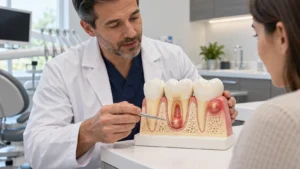
An impacted wisdom tooth is a third molar that has not fully come through the gum into a normal position. It may remain beneath the gum or emerge only partly. Some impacted teeth cause no symptoms; others are difficult to clean or become painful. Whether a tooth needs treatment depends on an examination and imaging, not on the word “impacted” alone.
What symptoms can an impacted wisdom tooth cause?
Possible signs include pain at the back of the mouth, gum tenderness or swelling, a bad taste, trouble cleaning behind the second molar, or difficulty opening the mouth. These symptoms can also come from decay, gum inflammation, or another dental problem. A dentist needs to identify the cause rather than assume the wisdom tooth is responsible. If the gum around a partly erupted tooth is inflamed, our guide to pericoronitis and healing explains that specific condition.
Contact a dentist promptly if pain is severe, swelling is increasing, you have fever, or eating and opening your mouth become difficult. If swelling affects breathing or swallowing, seek emergency medical care immediately.
How does a dentist diagnose an impacted wisdom tooth?
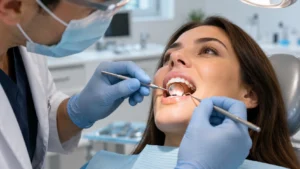
The visit starts with your symptoms and health history. The dentist examines the tooth, nearby gum, and the molar in front of it. Dental X-rays may show the position of the wisdom tooth and its relationship to neighboring structures. That information helps the clinician discuss whether the tooth can be monitored, whether another condition needs treatment, or whether removal is advisable. In more complex cases, the dentist may recommend an oral surgery consultation.
Does every impacted wisdom tooth need to be removed?
No. The American Dental Association notes that pain, infection, decay, cysts, gum disease, or damage to nearby teeth can be reasons to consider removal. A wisdom tooth that stays in place should still be monitored at regular dental visits. Your dentist can explain the benefits and risks of monitoring versus extraction in your particular case.
Do not wait for the problem to become extreme before seeking advice. A partly erupted tooth may be hard to keep clean, and recurring symptoms deserve assessment. At the same time, a healthy tooth should not be presented as an automatic emergency.
What if removal is recommended?
The procedure depends on where the tooth sits and how much of it has emerged. The treating clinician will explain the examination findings, the proposed extraction, appropriate anesthesia or sedation, and whether treatment can be performed at that location or requires referral. An impacted tooth may need an incision and may be removed in sections, but that is not true for every case. Ask what the plan means for your work, transport, and follow-up.
For a practical breakdown of the factors that affect your estimate, see wisdom tooth removal cost in Houston. No online article can provide an accurate personal quote without an examination.
What does recovery involve?
Recovery differs by procedure and person. Your dental team will give you instructions about food, oral hygiene, bleeding, medicines, and when to call. Mild swelling and discomfort during the first days can be expected after surgery, but worsening pain, fever, excessive bleeding, or other concerning symptoms should be reported to the treating clinician. Follow their instructions for protecting the extraction site; do not use a general timeline as a promise about when you will feel normal.
Frequently asked questions
Can an impacted wisdom tooth be painless?
Yes. Some impacted teeth are found during a routine exam or X-ray. Your dentist can decide whether monitoring is appropriate.
Can a dentist see me quickly if I have wisdom tooth pain?
URBN Dental offers same-day emergency appointments at several Houston-area locations, subject to availability. Tell the team about swelling, fever, and how long symptoms have lasted when you contact them. The examination determines the next step; same-day extraction is not guaranteed.
Will I need a specialist?
That depends on the tooth’s position and your clinical needs. The dentist can explain whether treatment can be provided at the selected office or whether an oral surgeon should assess you.
Get the tooth checked. Book online now or call to ask for the earliest appropriate appointment at a Houston-area URBN Dental location.
Clinical sources: American Dental Association: Wisdom Teeth; American Association of Oral and Maxillofacial Surgeons: Before Wisdom Teeth Surgery; AAOMS: Healing After Wisdom Tooth Extractions.