A knocked-out permanent tooth needs immediate dental attention. Handle it by the crown, keep it moist, and contact a dentist right away. Never put a knocked-out baby tooth back into the socket. If you are unsure which kind of tooth it is, get urgent advice rather than guessing.
After a fall or sports collision, everyone may be talking at once. Give one person the job of calling a dentist while another helps the injured person and looks for the tooth. Significant head or facial injury needs medical assessment as well.
The important difference: permanent tooth or baby tooth?
| Situation | First step | Avoid |
|---|---|---|
| A permanent tooth is completely out | Seek a dentist immediately. Keep the tooth moist and handle only its crown. | Scrubbing the root, letting it dry, or leaving it wrapped in tissue. |
| A baby tooth is completely out | Call a dentist who sees children for urgent advice and assessment. | Putting it back into the socket. |
| You cannot tell which type it is | Explain the child’s age and what happened when you call. Bring the tooth if found. | Assuming all teeth in a child’s mouth are baby teeth. |
The NHS knocked-out tooth guidance specifically warns against replanting a baby tooth because this can harm the permanent tooth developing below it. The person’s age alone is not a reliable way for a parent to identify every tooth.
What to do with a knocked-out permanent tooth
- Pick it up by the crown: the part that normally shows above the gum. Avoid touching the root.
- If dirty, rinse it gently and briefly. Do not scrub, disinfect, or scrape it clean.
- If it can be replaced safely and easily, gently return it to the socket. Do not force it. If the person cannot cooperate or you are unsure, keep it moist and seek immediate advice.
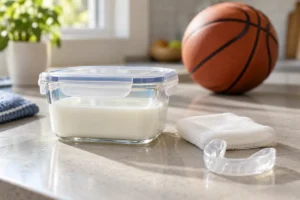
- If it cannot go back in, put it in milk or a tooth-preservation solution. Do not let it dry out. Do not store it in plain tap water.
- Go to a dentist immediately and bring the tooth. Tell the team how long it has been out and how it was stored.
The American Association of Endodontists recommends acting within 30 minutes when possible. That is a reason to act quickly, not a cutoff for giving up. Even if more time has passed, contact a dentist and bring the tooth.
Do not put a loose tooth inside a young child’s mouth for storage, where it could be swallowed or inhaled. Follow the emergency team’s instructions if there is a choking risk, loss of consciousness, or another serious injury.
What if the tooth is still in the mouth but has moved?
A tooth pushed sideways or deeper into the gum needs a different assessment from a tooth that is completely out. Do not try to pull it out to follow the steps above. Tell the dentist that it is displaced and whether your bite has changed.
A broken piece is another different situation: the remaining tooth may still be in place. Bring any fragment you find and describe what you see. The AAE traumatic injury guidance emphasizes prompt examination because nearby teeth may also have injuries that are not obvious.
For a chipped tooth rather than a tooth that is completely missing, see our broken tooth care information. Do not spend time comparing photos online before calling about an injury.
What to say when you call an emergency dentist
Start with “A permanent tooth has been knocked out,” if you know that is what happened. Then give the time of the injury, whether you have the tooth, how it is being kept, and whether the person has other injuries. For a child, give their age and ask whether the office can assess that age group immediately.
Confirm the office address and that someone can see you before driving there. If the location cannot help promptly, ask where to go next. A routine online request may not be read quickly enough for a knocked-out permanent tooth, so call.
What happens after the initial emergency visit?
Ask the dentist what follow-up is needed, how to care for the area, and which changes mean you should call again. Depending on the injury, a tooth may need repositioning, stabilization, or later treatment. Keeping the tooth in place on the first day does not mean follow-up can be skipped.
Useful questions include: “Which teeth were injured?”, “What can I eat?”, “When is the next review?”, and “Who do I call if something changes?” Ask for written instructions if you are shaken or helping someone else.
Finding urgent dental care in the Houston area
Find a Houston-area URBN Dental location and call now to explain the injury and confirm availability. Same-day emergency appointments are offered, but an individual office’s ability to treat a specific injury must be confirmed. For a child’s injury, ask about age suitability before traveling.
For less time-critical concerns or follow-up scheduling, you can also book online. A knocked-out permanent tooth should not wait for an online booking response.
Knocked-out tooth questions
Do I still need a dentist if I cannot find the tooth?
Yes. Explain that the tooth is missing after an injury. The dentist needs to assess the site and determine what happened; do not assume that an empty-looking space tells the whole story.
Can a knocked-out tooth always be saved?
No. The injury, time outside the mouth, storage, and clinical findings affect the options. Prompt care gives the dentist the best opportunity to evaluate it, but no article or booking team can promise survival.
Should I wait because the bleeding stopped?
No. A knocked-out permanent tooth remains urgent even if bleeding and pain settle. The priority is professional assessment, not waiting for another symptom.
General first-aid information only. Follow instructions from the dental or emergency medical team assessing the injury.